
Home/ISO Certification/ISO 13485 Servicing & Repair
ISO 13485 Certification for Medical Device Servicing and Repair
Independent service organisations, depot repair shops and component repair specialists work on finished devices without ever manufacturing one. ISO 13485 was written to cover that work, but almost everything published about the standard is aimed at manufacturers. We scope the standard to what your technicians actually do at the bench, build the system around your existing work orders rather than on top of them, and take you through Stage 1 and Stage 2 with an accredited certification body.

- A division of Liberty Management Group Ltd — established 2009
- Aurora, IL · Greater Chicago
- Submission-ready documentation
- On-time delivery
A Quality System Scoped to Service Work, Not Production
What ISO 13485 asks of a service organisation
Clause 7.5.4 is the one written for you. It asks for documented service procedures, the reference materials and measurement requirements needed to carry them out, records of every service performed, and — the part most shops miss — analysis of those records to catch what should have been handled as a complaint.
- Service procedures, work instructions and reference materials by modality
- Technician competence, training records and authorisation to sign off work
- Test equipment calibrated and traceable to national standards
- Replacement parts bought through evaluated and monitored suppliers
- Traceability of every unit serviced, by whom, and with which parts
From gap analysis to certification
We start at the bench, not in a binder. Reading a month of completed work orders and PM checklists usually shows that a working shop already does most of what the standard asks — undocumented, and inconsistent between technicians.
- Gap analysis against ISO 13485, with a documented scope and justified exclusions
- Quality manual, service procedures and records structure
- Calibration programme, recall schedule and parts control
- Complaint handling, reportability decisions and CAPA
- Support through Stage 1 and Stage 2 certification audits
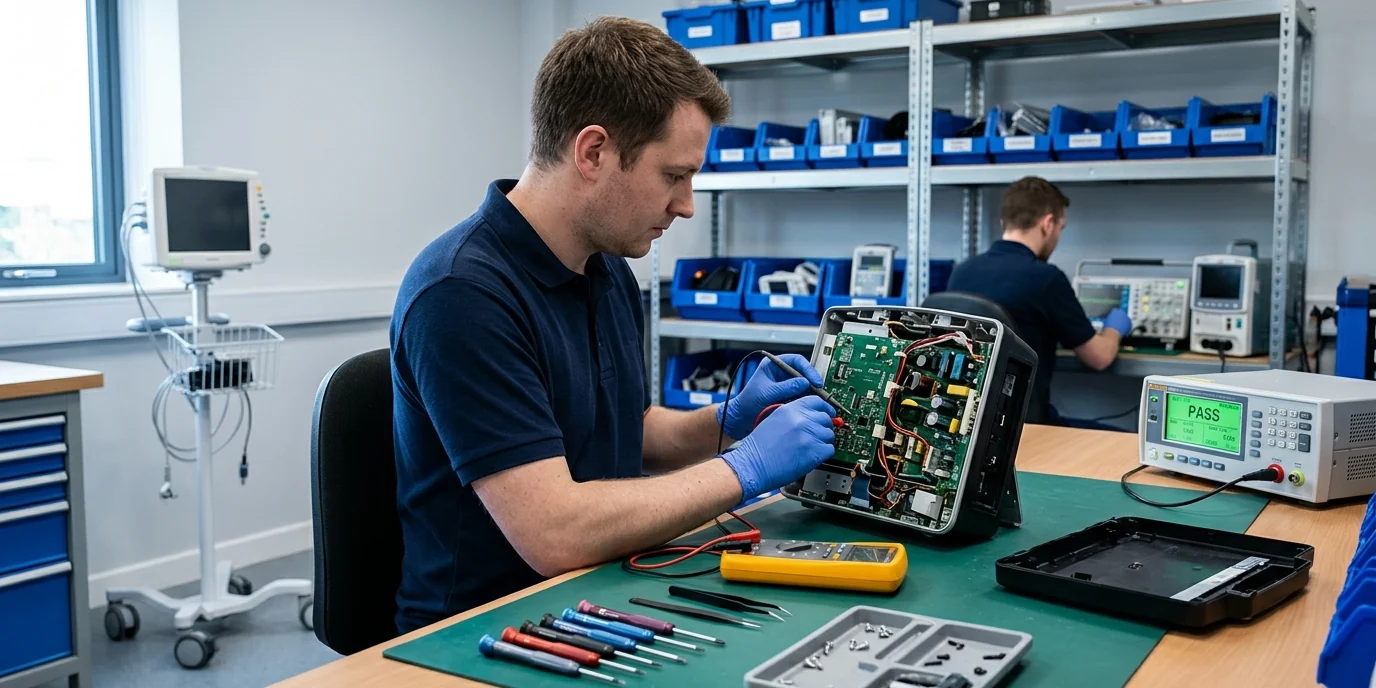
Devices and Components We Scope Service Systems Around
Scope is the first question an auditor asks and the first thing a customer checks. The table below is how we usually break it down: the device family, the parts that actually cross a bench, and the work that tends to push a job from servicing towards remanufacturing.
Scroll the table sideways to see every column.
| Device family | Typical components and examples | Class | Service work, and where the line moves |
|---|---|---|---|
| Imaging and radiology | |||
| Diagnostic X-ray and fluoroscopy | X-ray tubes, generators, collimators, flat panel detectors, image intensifiers, R/F tables | II | Tube and detector replacement, calibration, kV/mAs verification. Changing output specifications or fitting a non-equivalent detector moves towards remanufacturing |
| Mobile and surgical C-arms | Tube heads, monoblocks, image chains, motorised drives | II | Image chain repair, mechanical rebuild, software reload to the OEM version |
| CT scanners | X-ray tubes, slip rings, detector arrays, gantry drives, patient tables | II | Tube swaps, detector calibration, gantry alignment. Reconstruction parameter changes can affect performance specifications |
| MRI systems | Gradient amplifiers, RF coils, cold heads, compressors, chillers, patient tables | II | Cold head and coil service, cryogen support, coil repair. Rewinding a coil off-specification is remanufacturing |
| Ultrasound systems and transducers | TEE, TTE, linear, curved and endocavity probes; lenses, cables, connectors, array elements | II | Probe repair and re-lensing, element replacement, cable and connector repair |
| Mammography | Detectors, compression paddles, AEC sensors, biopsy add-ons | II | Service carries an MQSA overlay on top of the quality system — calibration and phantom records matter more, not less |
| Nuclear medicine and PET | Gamma camera heads, photomultiplier tubes, PET detector blocks, collimators | II | Detector tuning, PMT replacement, uniformity correction |
| Bone densitometry (DEXA) | Detectors, scan arms, calibration phantoms | II | Calibration, scan arm mechanics, phantom verification |
| Patient monitoring and diagnostics | |||
| Multiparameter patient monitors | ECG boards, SpO2 modules, NIBP pumps and valves, displays, batteries | II | Module repair, pressure calibration, display and touch replacement |
| Telemetry and central stations | Transmitters, receivers, antennas, servers | II | Transmitter repair, antenna survey, network and server maintenance |
| ECG and stress systems | Patient cables, acquisition modules, treadmill drives, thermal printers | II | Acquisition module repair, cable replacement, printer service |
| Fetal and maternal monitors | Ultrasound and toco transducers, printers, interface boards | II | Transducer repair, print head replacement, calibration |
| EEG, EMG and evoked potential | Amplifiers, headboxes, electrode inputs, isolation circuits | II | Amplifier repair, isolation and leakage testing |
| Pulse oximetry and capnography | Sensors, sampling lines, water traps, gas benches | II | Gas bench calibration, sensor repair, flow verification |
| Life support and therapy | |||
| Ventilators (ICU, transport, home) | Blowers, flow and oxygen sensors, exhalation valves, turbines, batteries | II | Sensor and valve replacement, flow calibration. Altering delivered volume or pressure ranges is remanufacturing |
| Anaesthesia machines | Vaporisers, CO2 absorbers, ventilator modules, gas blenders, flow sensors | II | Vaporiser service and calibration, leak and gas delivery verification |
| Infusion pumps (volumetric, syringe, PCA, enteral) | Pumping mechanisms, door and occlusion sensors, drive motors, batteries, drug libraries | II | Mechanism rebuild, occlusion calibration, battery replacement. Editing the drug library or flow accuracy limits moves the job |
| Defibrillators and AEDs | Capacitors, high-voltage boards, paddle and pad connectors, ECG front ends, batteries | II–III | Energy output verification, capacitor and board repair. Waveform or energy changes are remanufacturing |
| Dialysis machines and water systems | Hydraulic blocks, conductivity cells, blood and dialysate pumps, heaters, RO units | II | Hydraulic rebuild, conductivity and temperature calibration, RO service |
| Electrosurgical units | Generators, footswitches, return electrode monitors, handpieces | II | Power output verification, REM circuit repair, footswitch rebuild |
| Surgical and aesthetic lasers | Laser heads, fibres, handpieces, cooling systems, power supplies | II–III | Fibre and handpiece repair, output calibration, cooling service |
| Perfusion, IABP and circulatory support | Pump heads, consoles, drive lines, transducers | III | Console repair and calibration under tight documentation and traceability expectations |
| Physical therapy and rehabilitation | TENS and stimulation units, therapeutic ultrasound heads, traction units | II | Output verification, transducer replacement |
| Surgical, endoscopy and sterile processing | |||
| Rigid endoscopes and laparoscopes | Rod lens systems, light posts, sheaths, eyepieces, seals | II | Optical rebuild, re-lensing, leak testing, sheath straightening |
| Flexible endoscopes | Insertion tubes, angulation systems, bending rubbers, CCD and light guides, channels | II | Channel and insertion tube replacement, angulation rebuild, leak testing |
| Camera systems and light sources | Camera heads, couplers, CCUs, LED and xenon lamps, light cables | II | Camera head repair, coupler optics, light cable rebuild |
| Surgical microscopes | Objective and eyepiece optics, focus drives, counterbalance arms, illumination | II | Optical cleaning and alignment, drive repair, balance calibration |
| Powered surgical instruments | Drill and saw handpieces, shaver motors, batteries, chargers, hoses | II | Handpiece rebuild, motor and bearing replacement, battery pack service |
| Sterilisers and washer-disinfectors | Steam generators, door gaskets and seals, vacuum pumps, chamber sensors, controllers | II | Chamber and door service, cycle and temperature calibration, gasket replacement |
| Surgical tables, booms and lights | Hydraulics, actuators, controllers, LED heads, brake systems | I–II | Actuator and hydraulic service, controller repair, light head replacement |
| Robotic surgery accessories and components | Instrument arms, cameras, cable drives, consoles | II | Arm and cable service within OEM specifications; instrument reuse limits are a hard boundary |
| Laboratory and support equipment | |||
| Chemistry and haematology analysers | Sample probes, pipettors, optics and flow cells, reagent handling | I–II | Probe and optics service, calibration and linearity verification |
| Centrifuges, incubators and microscopes | Rotors, drives, heaters, optics, controllers | I | Speed and temperature calibration, drive and rotor inspection |
| Blood bank and laboratory refrigeration | Compressors, controllers, alarm and probe circuits, chart recorders | II | Temperature calibration, alarm verification, compressor service |
| Point-of-care and near-patient testing | Readers, docking stations, barcode modules, batteries | I–II | Reader calibration, dock and connectivity repair |
| Medical gas and suction equipment | Regulators, flowmeters, vacuum regulators, outlets, manifolds | II | Flow and pressure calibration, seal and diaphragm replacement |
| Beds, stretchers, lifts and mobility | Actuators, control boxes, scales, batteries, brake and side rail mechanisms | I–II | Actuator and control repair, scale calibration, load testing |
| Batteries, power supplies and chargers | Device battery packs, SMPS boards, isolation transformers, UPS units | I–II | Pack rebuild and power supply repair. Fitting cells of a different chemistry or capacity than specified is remanufacturing |
Classes shown are typical. Classification depends on the specific product code and intended use, and the servicing and remanufacturing notes above are general guidance rather than a determination for any one job — we scope both properly as part of the engagement.
Servicing or Remanufacturing?
FDA’s final guidance on remanufacturing, issued in 2024, draws the line that matters to every service organisation. Servicing restores a device to the original manufacturer’s safety and performance specifications and intended use. Remanufacturing is any processing, conditioning, renovating, repackaging or restoring that significantly changes those specifications or the intended use — and FDA judges an entity by the activities it actually performs, not by what it calls itself.
The consequences are not small. Stay on the servicing side and you are not pulled into FDA registration and listing. Cross into remanufacturing and you take on registration and listing, compliance with the Quality Management System Regulation, adverse event reporting, and in some cases a marketing submission for a device you thought you were only repairing.
Since the QMSR took effect on 2 February 2026, FDA’s quality requirements for devices are built directly on ISO 13485:2016. A shop already running a certified system is most of the way to compliance if a determination ever goes against it — and in the meantime holds the document an OEM service agreement, a hospital vendor credentialing pack or a device manufacturer’s supplier audit will ask for. FDA does not require certification; it requires compliance. Your customers are the ones asking for the certificate.
More ISO Consulting from Liberty Compliance
Need Help with Compliance?
Our experts are ready to help you navigate regulatory requirements and achieve your certification goals.
Tell us about your devices and where you are with ISO 13485, and we will reply within one business day.
Experienced Experts
Hands-on experience in regulatory compliance and management systems.
Tailored Solutions
Solutions that fit your business, industry, and product requirements.
On-Time Delivery
Efficient and reliable service to help you meet your business deadlines.